Polling engine
The engine brings the whole research workflow into one place, from the questionnaire coming in to the finished client dashboard.
Because the team controls every step, a poll can go into the field the day the questionnaire is final, and the results reach the client as an interactive dashboard instead of a PDF of crosstabs.
- Poll intake
- Universe counts and list cutting up front, so the team knows the exact scope before a survey goes out
- Dashboard production
- Simultaneous collaboration on the same dashboard
- An AI-assisted editor that makes structural dashboard changes from a plain-language request
From a final questionnaire to results in front of the client.
One dense page split into three cleaner pages from a single plain-language request, with no developer ticket.
Moving a chart, shortening labels, rearranging a section or splitting a page used to be a development task. Now the researcher who knows what the poll says can make the change directly, and developers spend their time on harder problems.
Modeling platform
The modeling platform carries what a poll learned across the voter file and turns it into a workspace where the campaign makes its targeting decisions.
The campaign builds the audience it wants, watches the count change as it goes, sees the messages that matter to those voters and pulls the contact list from the same screen.
- Build target universes
- Live universe counts
- Message guidance tied to the audience you selected
- Generate the contact list
How it works, following one voter. Illustrative data, fictional race.
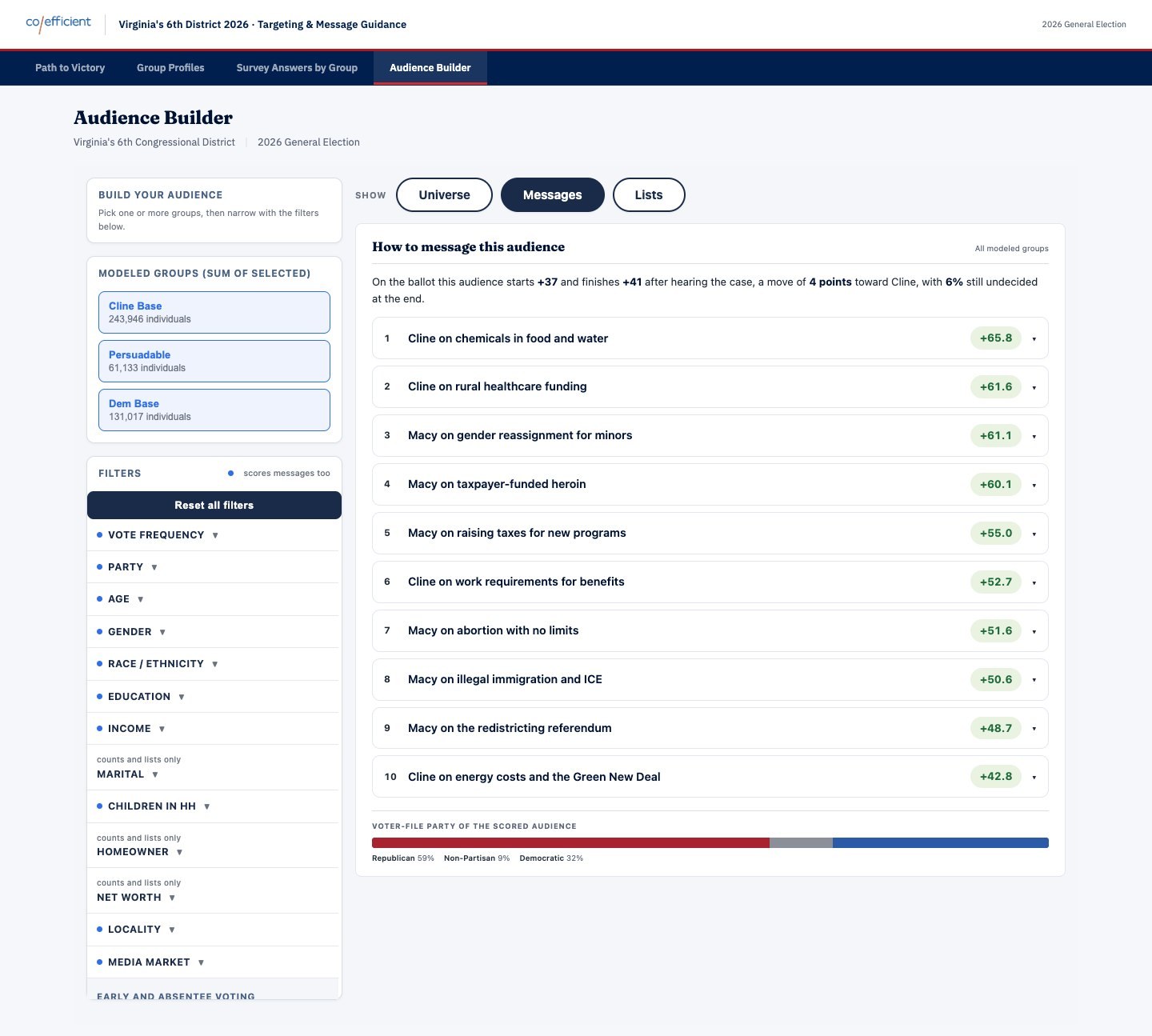
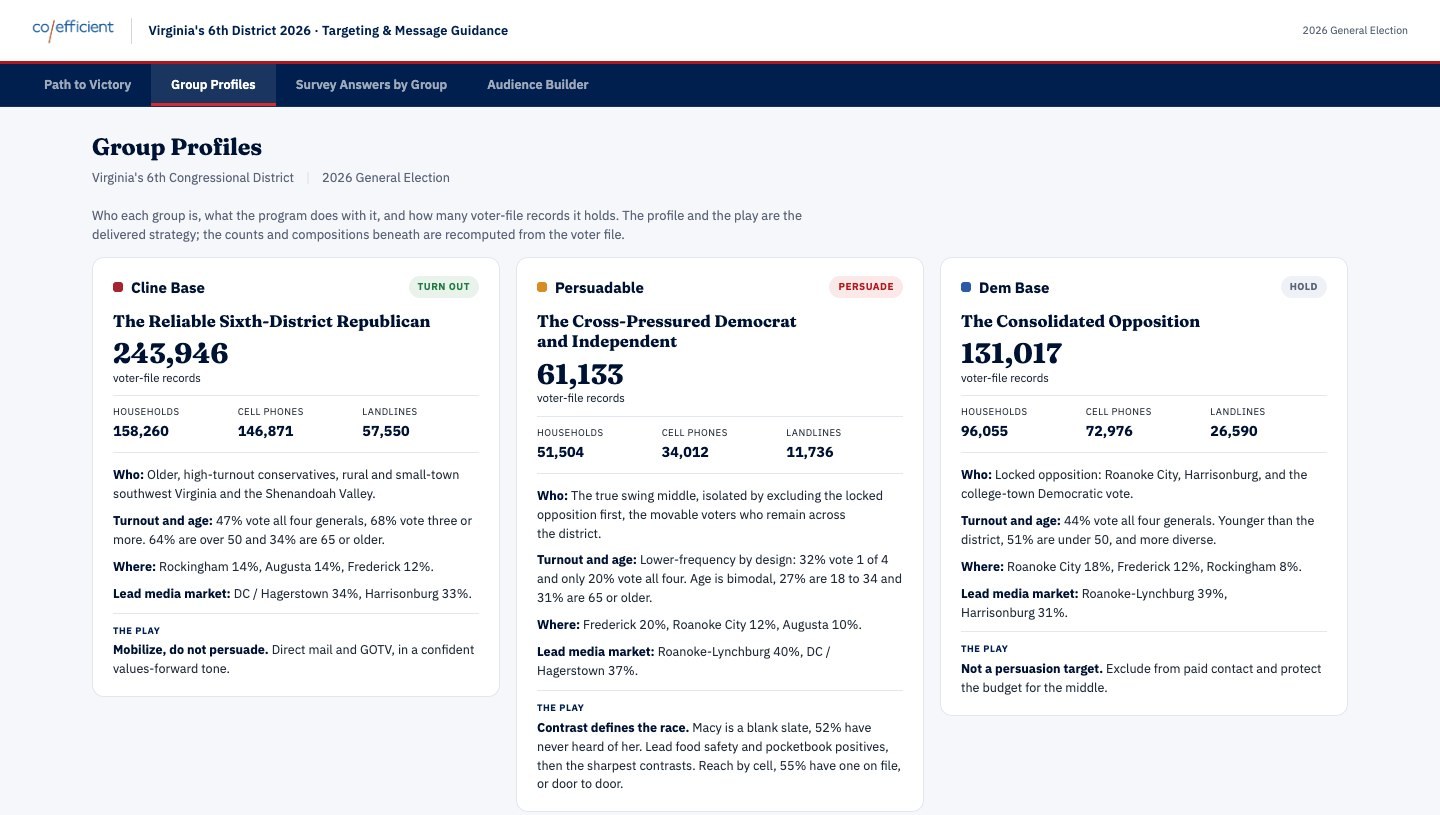
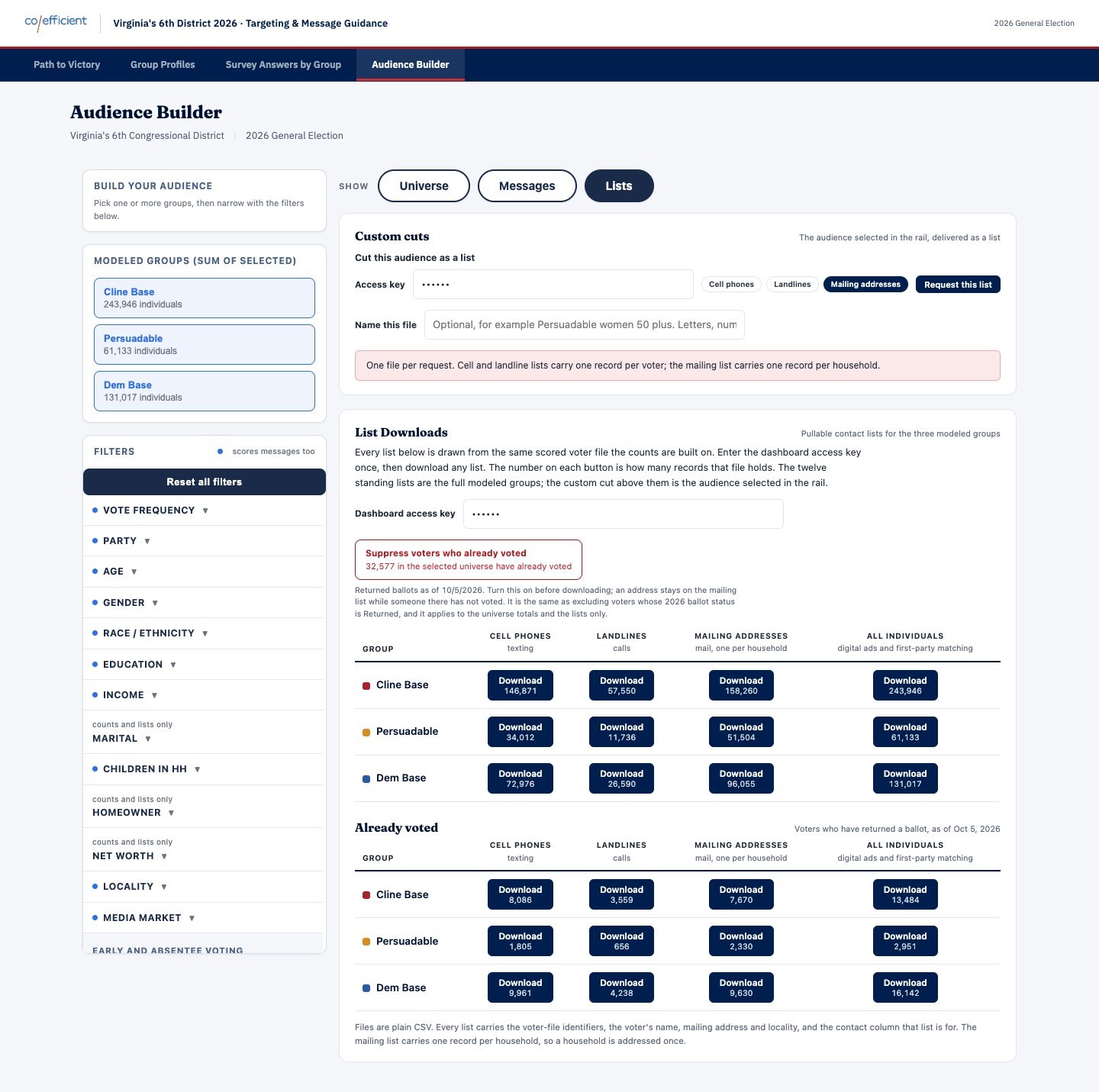
Scored in one program, with the campaign building and adjusting its own target audiences.
Finding, audience, message and list in one place, instead of separate steps between research, data, strategy and outreach.
The dashboard became the place where the targeting decision was made, not just where results were viewed.
co/nnect texting
co/nnect is the team's own political texting platform, built from years of running texting programs on other people's software since 2019.
The operating loop is deliberately simple: upload, create the project, send and monitor. The complexity sits underneath, where operators don't have to manage it.
- Reporting on what is delivering and what it cost
- Historical campaign and message context when the team needs it
- Safeguards that pause certain problem sends, alert the team and wait for a human decision
- A data-lake architecture that keeps message history accessible at scale
- Reply Tags: ask a question about a project's replies in plain language
Reply Tags: every reply read in the context of the message that prompted it.
Upload, create the project, send, monitor.
Detectable sending problems stop the send and bring a human back into the decision before they compound.
After years of adapting to other platforms, the team stopped working around someone else's software and built the one its operators wanted to use.
Action Advocacy
Action Advocacy turns issue education into immediate action. A custom page explains the issue, gives a clear call to action and lets the visitor send an email or text to the right decision-maker without leaving the page.
- Understand the issue
- Take action
- Reach the decision-maker
Organizations spend real money making people care, then lose them in the steps between interest and action: leaving the page, finding the official, finding the contact information, writing the message.
Action Advocacy removes those steps, so caring becomes a message in a decision-maker's inbox instead of a page view in an analytics report.
Custom and internal tools
When a client's problem doesn't fit a standard product, the team builds the dashboard, tracker or tool around it.
The same instinct points inward. When a workflow wastes staff time, the team builds the tool that removes it.
The team built the infrastructure and guardrails that let the people closest to a workflow help shape or build the solution, instead of sending every good idea into an engineering queue.
An 89% to 94% reduction in time for each registration.
One afternoon of product work now returns hours of staff time every week.